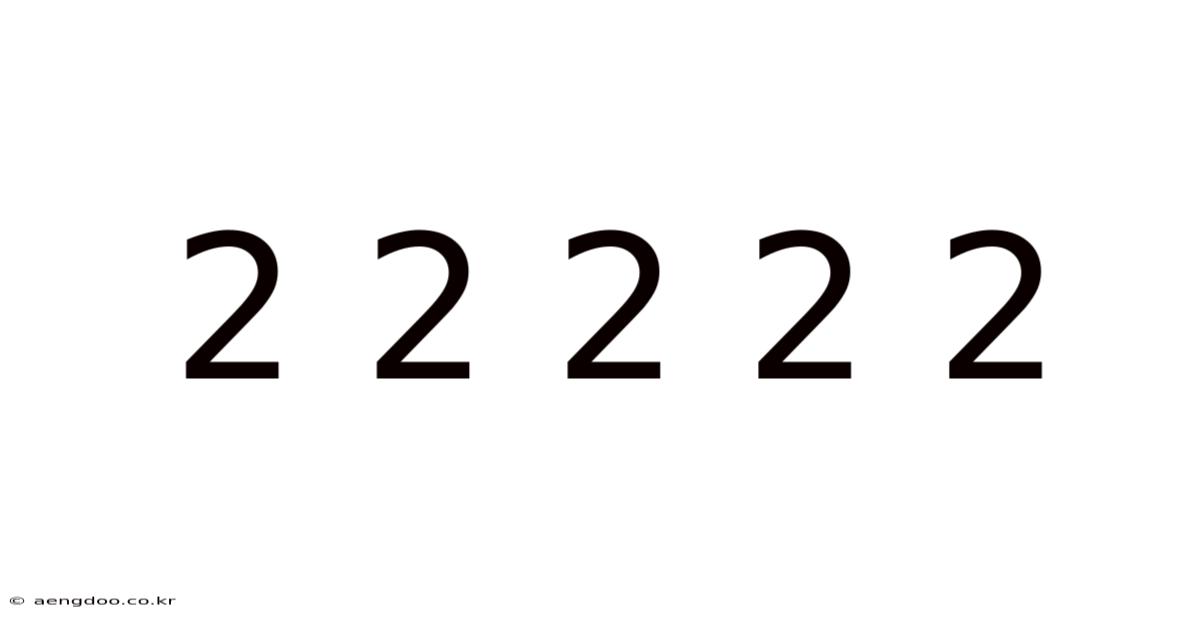
Decoding the Mystery: Exploring the Mathematical and Philosophical Implications of 2 2 2 2 2
The seemingly simple sequence "2 2 2 2 2" might appear unremarkable at first glance. That said, this seemingly mundane string of numbers offers a fascinating opportunity to explore various mathematical concepts, walk through the philosophical implications of repetition, and even touch upon the human fascination with patterns. This article will dig into the depths of this seemingly simple sequence, exploring its potential meanings and interpretations across different fields.
Introduction: The Allure of Repetition
The repetition of the number 2 immediately draws our attention. Also, repetition itself is a fundamental aspect of our experience; it's how we perceive rhythm in music, recognize patterns in nature, and learn through practice. So in mathematics, repetition manifests in various forms, from simple arithmetic sequences to complex fractal patterns. The repeated "2" challenges us to move beyond the superficial and consider its deeper implications. Worth adding: this sequence invites us to explore different mathematical perspectives, from basic arithmetic to more advanced concepts like combinatorics and number theory. Beyond the mathematical realm, the consistent repetition of "2" opens avenues to explore philosophical interpretations about the nature of repetition, identity, and the search for meaning in seemingly simple occurrences.
Mathematical Explorations: Beyond Simple Addition
At its most basic level, "2 2 2 2 2" can be interpreted as a simple addition problem: 2 + 2 + 2 + 2 + 2 = 10. This seemingly trivial calculation lays the foundation for further exploration. We can expand upon this by considering:
-
Multiplication: The repeated addition can be expressed more concisely as 5 x 2 = 10. This introduces the concept of multiplication, a fundamental operation in mathematics.
-
Powers and Exponentiation: While not directly apparent, the sequence can be linked to exponents. We can consider 2⁵ (2 raised to the power of 5), which also equals 32. This highlights the exponential growth that occurs when a base number is repeatedly multiplied. While not directly represented by the sequence itself, this connection underscores the potential for expansion and growth inherent in seemingly simple numerical patterns.
-
Combinatorics and Permutations: Imagine we have five distinct objects, each represented by the number 2. The number of ways we can arrange these objects (permutations) is 5! (5 factorial), which equals 120. This shows how a simple sequence can lead to unexpectedly large numbers and complex mathematical ideas Practical, not theoretical..
-
Binary Representation: In the world of computer science, the number 2 holds significant importance as the base of the binary system. The sequence, though not directly a binary number itself, invites consideration of how binary representations work, building upon the fundamental importance of the number 2 in computing.
Philosophical Interpretations: Exploring the Meaning of Repetition
Moving beyond the purely mathematical, the repeated "2" raises philosophical questions. The consistent repetition challenges our understanding of:
-
Identity and Difference: Are all the "2"s identical? Philosophically, the concept of identity and difference becomes relevant. While mathematically they are identical, we can consider different contexts in which a repeated "2" might signify something unique. Each instance might have a different origin, context or meaning even though numerically they are the same.
-
Meaning and Significance: Does the repetition of "2" inherently hold meaning, or is meaning imposed upon it by the observer? This touches upon the question of whether patterns are inherent in reality or are constructed by the human mind. The simple sequence could be interpreted through various lenses, lending itself to subjective interpretations.
-
The Nature of Reality: Is the repetitive nature of the sequence indicative of underlying patterns and order within the universe? The sequence, in its simplicity, can act as a metaphor for the search for order and pattern in seemingly chaotic systems.
-
The Search for Patterns: The human mind has a natural inclination towards pattern recognition. This sequence exemplifies that innate drive to find order and structure within even the simplest sets of data. Our brains are hardwired to seek connections and make sense of the world, and this simple sequence represents the beginning of that process.
Expanding the Scope: Connections to Other Fields
The sequence "2 2 2 2 2" is not limited to mathematical and philosophical interpretations. Its simplicity allows for connections to other fields:
-
Music Theory: The number 2 plays a significant role in music theory, appearing in scales, intervals, and rhythmic patterns. The repetition could be seen as a simplified representation of rhythmic patterns, or a minimalist musical motif waiting to be expanded upon That's the part that actually makes a difference..
-
Art and Design: Minimalist art often utilizes repetition and simplicity. The sequence could inspire artistic exploration, with the repeated "2" forming the basis for a visual pattern or a conceptual artwork And it works..
-
Nature and Science: Repetition and patterns are ubiquitous in nature, from the spiral arrangement of leaves to the hexagonal structure of honeycombs. The sequence, though seemingly arbitrary, serves as a reminder of the underlying order and patterns found throughout the natural world And that's really what it comes down to..
Frequently Asked Questions (FAQ)
-
What is the significance of the number 2? The number 2 is a foundational number in mathematics, representing duality, pairing, and the simplest even number. Its significance is amplified in this context through its repetition.
-
Are there any deeper mathematical meanings hidden within the sequence? While the sequence itself is simple, it serves as a gateway to exploring a wide range of mathematical concepts, from basic arithmetic to more advanced areas like combinatorics and number theory.
-
Can this sequence be used in a practical application? While it may not have a direct practical application in its current form, the concepts it introduces—repetition, pattern recognition, and mathematical operations—are crucial for various fields, including computer science, engineering, and data analysis.
-
What is the philosophical implication of the repetition? The repetition of the number 2 invites introspection on the nature of identity, difference, meaning, and the inherent human drive to seek patterns and order in the world That's the part that actually makes a difference. Nothing fancy..
Conclusion: A Simple Sequence, Profound Implications
The seemingly simple sequence "2 2 2 2 2" proves to be remarkably rich in its potential interpretations. The beauty of this exercise lies in its ability to illustrate how a seemingly simple sequence can open up a wide range of intellectual explorations, demonstrating the limitless possibilities inherent in the pursuit of knowledge. From basic arithmetic to complex philosophical inquiries, this sequence serves as a powerful reminder that even the simplest things can hold surprising depth and complexity. By exploring this sequence, we not only learn about mathematical concepts but also engage in a deeper reflection on the human experience and our constant search for meaning and structure within the universe. Its repetitive nature highlights the pervasive role of pattern recognition in shaping our understanding of the world, both in the realm of mathematics and in our broader philosophical interpretations of reality. The continued investigation of such simple patterns, therefore, remains a vital component in expanding our understanding of both the mathematical and philosophical landscapes Worth keeping that in mind..
