3 3 3 3 3

aengdoo
Sep 04, 2025 · 6 min read
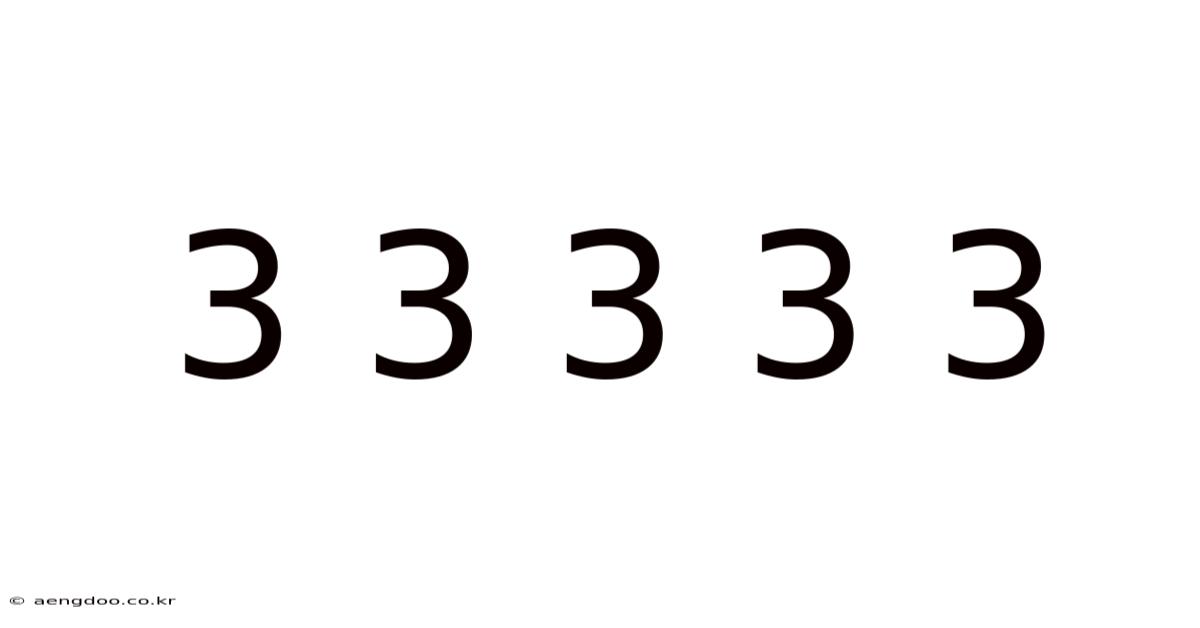
Table of Contents
Decoding the Mystery: Exploring the Mathematical and Philosophical Implications of "3 3 3 3 3"
The seemingly simple sequence "3 3 3 3 3" holds a surprising depth, inviting exploration across various fields, from basic mathematics to abstract philosophy. While lacking inherent mathematical operations or a pre-defined formula, its repetitive nature sparks curiosity and opens avenues for creative interpretations. This article delves into the potential meanings and interpretations of this sequence, examining its mathematical properties, exploring its presence in various systems, and considering its philosophical implications.
I. Mathematical Interpretations: Beyond the Obvious
At first glance, "3 3 3 3 3" presents a straightforward sequence of five identical numbers. However, even within mathematics, we can explore different perspectives:
-
Repetitive Pattern Recognition: The most immediate observation is the perfect repetition. This uniformity speaks to concepts of symmetry and regularity, fundamental aspects of many mathematical structures. This repetition could be viewed as a simple, yet elegant, recursive pattern where the rule is simply "repeat the previous number."
-
Base Systems: The number 3 itself offers further exploration. It's a prime number, meaning it's only divisible by 1 and itself. This prime nature adds a layer of mathematical significance. Considering different base systems, the sequence remains consistent – 3 remains "3" regardless of whether we use base 10, binary, or hexadecimal. This unchanging property highlights the sequence's robustness across mathematical frameworks.
-
Statistical Analysis: While a small sample size, we could treat this sequence as a basic statistical dataset. The mean, median, and mode are all 3, reflecting the extreme uniformity. The standard deviation would be zero, indicating no variability within the data. This extreme simplicity allows for a clear and unambiguous statistical description.
-
Combinatorial Aspects: We could delve into combinatorics, though the opportunities are limited with this specific sequence. For instance, we might ask how many permutations of this sequence exist if we were to allow rearrangement. Since all numbers are identical, there is only one unique permutation. This lack of variability again highlights the extreme simplicity of the sequence.
II. Exploring the Sequence in Different Systems: Numbers Beyond Numerals
While the sequence’s mathematical properties are limited, its application and interpretation extend beyond the realm of pure numerical analysis. Let's consider how this sequence could appear and be interpreted within different contexts:
-
Music Theory: The number 3 is prevalent in musical theory. Three-part harmonies (triads) are fundamental building blocks of Western music. We could imagine "3 3 3 3 3" representing five iterations of a three-note chord progression, a repetitive musical motif, or even five different three-beat phrases. The repetition could symbolize a simple, hypnotic rhythm or a deliberate, minimalist composition.
-
Art and Design: The number 3 holds visual significance. Think of triptychs in painting, the three primary colors, or the three dimensions of space. "3 3 3 3 3" could represent a visual pattern with five repetitions of a three-element motif. This could translate into a series of artworks, a geometric design, or an architectural pattern. The repetition might suggest a sense of order, stability, or even monotony depending on the artistic interpretation.
-
Literature and Narrative: Repetition of numbers can create a specific atmosphere in literature. Five instances of the number 3 could evoke a sense of heightened significance, a ritualistic element, or a symbolic representation of a threefold concept repeated across a narrative. The repetition might symbolize an obsessive thought, a recurring theme, or a deliberately simple, almost mantra-like quality.
-
Scientific Context (Hypothetical): While there's no known direct correlation, we could imagine hypothetical scenarios. Perhaps in a specific scientific model, “3 3 3 3 3” represents a series of measurements or observations showing consistent, unchanging values. The constant repetition might highlight stability in a dynamic system or point to a need for further investigation to determine if this is an anomaly or a true underlying pattern.
III. Philosophical Interpretations: Meaning Beyond Numbers
Moving beyond the concrete realm of mathematics and specific systems, the sequence invites philosophical reflections:
-
The Nature of Repetition: The sequence inherently highlights the concept of repetition. Philosophically, repetition raises questions about the nature of time, causality, and the very meaning of experience. Is repetition monotonous or revealing of an underlying truth? Does it imply a lack of progression or an essential stability?
-
The Meaning of Simplicity: The sequence's stark simplicity itself becomes a subject of philosophical inquiry. Is simplicity a sign of triviality or a pathway to deeper understanding? Does the lack of complexity point towards an underlying fundamental principle, or is it simply random? The philosophical debate between complexity and simplicity resonates with the inherent nature of this numerical sequence.
-
The Search for Patterns: The human mind is naturally inclined to seek patterns and meaning. The repetitive nature of “3 3 3 3 3” triggers this innate drive. The search for meaning within this sequence mirrors our wider search for order and understanding in a seemingly chaotic world. This quest for meaning transcends the specific context of numbers, raising fundamental questions about our relationship with the universe and the structures we perceive.
-
Existential Considerations: The constant repetition could also be seen as a metaphor for aspects of human existence. The monotony might reflect the cyclical nature of life, routines, or even existential anxieties. Conversely, the consistent repetition could represent a sense of stability, grounding, or unwavering commitment within a chaotic existence.
IV. Frequently Asked Questions (FAQ)
Here are some questions that frequently arise when contemplating this seemingly simple sequence:
-
Q: Does the sequence have any specific mathematical significance beyond its obvious simplicity?
- A: No, the sequence itself doesn't possess any inherent mathematical significance within established mathematical frameworks. Its value lies in its potential for interpretation across various disciplines and its ability to stimulate philosophical reflection.
-
Q: Could this sequence be used in a cryptographic context?
- A: It's highly unlikely. Due to the extreme simplicity and repetition, this sequence offers no security in cryptography. More complex and unpredictable patterns are essential for cryptographic applications.
-
Q: Is there a deeper, hidden meaning behind the sequence?
- A: The "deeper meaning" is entirely dependent on interpretation. There's no objectively "correct" answer. Its value lies in its potential for exploration across diverse fields and its capability to prompt creative and philosophical thought.
-
Q: Are there similar sequences that hold more mathematical or scientific significance?
- A: Yes, many sequences in mathematics, like the Fibonacci sequence or prime number sequence, possess far richer mathematical properties and scientific applications. These sequences display complex patterns and relationships relevant to diverse fields.
V. Conclusion: The Enduring Power of Simplicity
"3 3 3 3 3," in its apparent simplicity, offers a surprisingly rich opportunity for exploration and contemplation. While lacking intrinsic mathematical complexity, its repetitive structure invites analyses across numerous domains, from straightforward statistical descriptions to complex philosophical inquiries. The sequence serves as a reminder of how seemingly simple elements can spark profound reflection and inspire creative interpretations. Its power lies not in its inherent properties but in its ability to activate our inherent human tendencies to seek patterns, ascribe meaning, and explore the universe around us, both concrete and abstract. The sequence stands as a testament to the fact that even the most basic structures can hold immense potential for exploration and understanding. The lasting impact of “3 3 3 3 3” ultimately rests in its ability to inspire thought and discussion, rather than provide concrete answers.
Latest Posts
Related Post
Thank you for visiting our website which covers about 3 3 3 3 3 . We hope the information provided has been useful to you. Feel free to contact us if you have any questions or need further assistance. See you next time and don't miss to bookmark.
