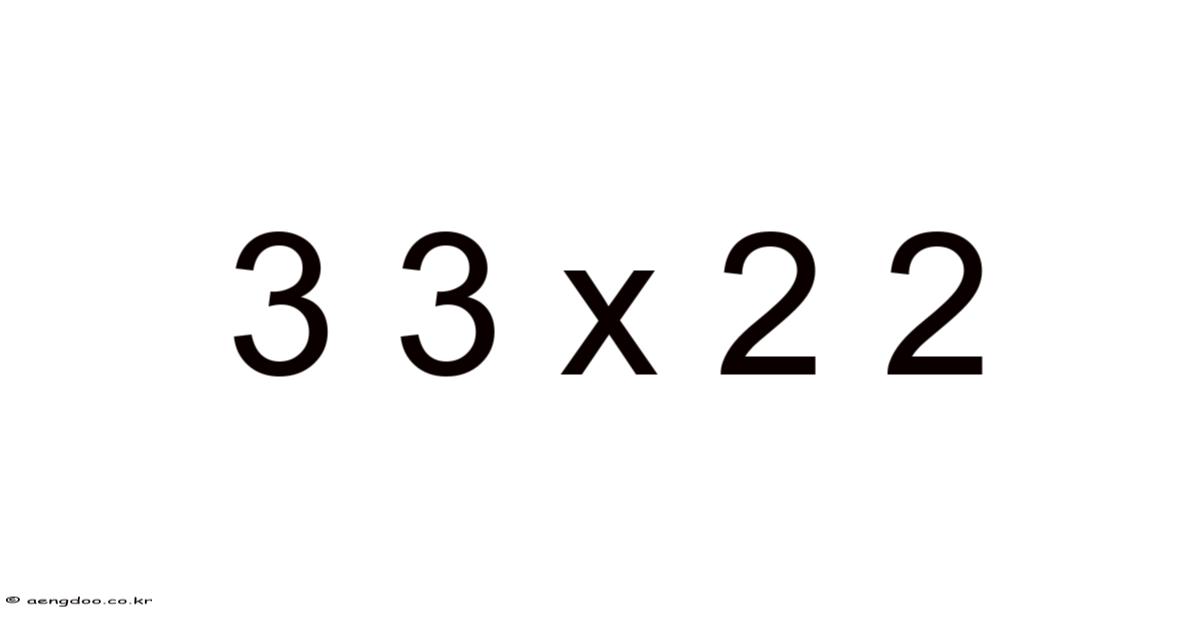
Decoding the Mystery: A Deep Dive into 3 x 3 x 2 x 2
The seemingly simple expression "3 x 3 x 2 x 2" might appear straightforward at first glance. That said, this seemingly basic arithmetic problem opens doors to exploring fundamental concepts in mathematics, from basic multiplication to more advanced ideas about prime factorization and order of operations. This article will dissect this expression, examining its solution, the underlying principles, and extending the discussion to related mathematical concepts. We'll explore why understanding this seemingly simple equation is crucial for building a stronger mathematical foundation.
Understanding the Fundamentals: Multiplication and Order of Operations
Before diving into the intricacies, let's refresh our understanding of the core concepts involved: multiplication and the order of operations Small thing, real impact..
-
Multiplication: Multiplication is a fundamental arithmetic operation representing repeated addition. Take this: 3 x 2 means adding 2 three times (2 + 2 + 2 = 6) Took long enough..
-
Order of Operations (PEMDAS/BODMAS): This crucial set of rules dictates the sequence in which we perform calculations within an expression. The acronyms PEMDAS (Parentheses, Exponents, Multiplication and Division, Addition and Subtraction) and BODMAS (Brackets, Orders, Division and Multiplication, Addition and Subtraction) represent the same order. Multiplication and division have equal precedence, as do addition and subtraction. We proceed from left to right when operations have equal precedence. The absence of parentheses or exponents in "3 x 3 x 2 x 2" simplifies the process considerably Turns out it matters..
Solving 3 x 3 x 2 x 2: A Step-by-Step Approach
Given the absence of parentheses or exponents, we simply proceed from left to right, performing the multiplications sequentially:
-
3 x 3 = 9: We begin by multiplying the first two numbers.
-
9 x 2 = 18: Next, we multiply the result (9) by the third number.
-
18 x 2 = 36: Finally, we multiply the result (18) by the last number Small thing, real impact. No workaround needed..
So, the solution to 3 x 3 x 2 x 2 is 36.
Expanding the Horizon: Prime Factorization and its Significance
The solution, 36, can be further analyzed through prime factorization. Prime factorization involves expressing a number as a product of its prime factors – numbers divisible only by 1 and themselves Simple, but easy to overlook..
The prime factorization of 36 is 2² x 3². This means 36 can be expressed as 2 x 2 x 3 x 3. This representation provides valuable insights:
-
Understanding Divisibility: Prime factorization helps us understand which numbers divide evenly into 36. Since 2 and 3 are the prime factors, we know that 2, 3, 4, 6, 9, 12, 18, and 36 are all divisors of 36.
-
Simplifying Fractions: In more advanced mathematical contexts, like simplifying fractions or working with rational numbers, prime factorization becomes an indispensable tool.
-
Foundation for Advanced Concepts: Prime factorization forms the bedrock for various advanced mathematical concepts, including modular arithmetic and cryptography Turns out it matters..
Exploring Related Concepts: Exponents and Powers
The expression "3 x 3 x 2 x 2" can be rewritten using exponents. Exponents (or powers) indicate repeated multiplication. We can rewrite the expression as:
3² x 2²
This representation is more concise and highlights the repeated multiplication of 3 and 2. Understanding exponents is crucial for simplifying complex mathematical expressions and tackling more advanced mathematical concepts such as polynomials and exponential functions.
Beyond the Basics: Applications in Real-World Scenarios
While seemingly simple, the concept of multiplication and the principles demonstrated in solving 3 x 3 x 2 x 2 find numerous applications in everyday life and various professional fields Small thing, real impact..
-
Calculating Areas and Volumes: Determining the area of a square (side x side) or the volume of a rectangular prism (length x width x height) directly involves multiplication. Understanding this fundamental operation is essential for tasks ranging from home improvement projects to engineering calculations Simple as that..
-
Financial Calculations: Calculating simple interest, compound interest, or determining the total cost of multiple items all rely heavily on multiplication. These skills are crucial in personal finance, business accounting, and investment analysis.
-
Data Analysis and Statistics: Many statistical calculations, such as calculating averages, frequencies, or probabilities, depend on multiplication. This is essential for fields like data science, market research, and epidemiology And that's really what it comes down to. Still holds up..
-
Computer Programming: Multiplication is a core operation in most programming languages. Understanding it is foundational for developing algorithms and solving computational problems.
Frequently Asked Questions (FAQ)
Q: What if the order of the numbers in the expression was changed? Would the answer be different?
A: No, the answer would remain the same. Multiplication is commutative, meaning the order of the numbers does not affect the product. 3 x 3 x 2 x 2 is equal to 2 x 3 x 2 x 3, and so on Worth keeping that in mind..
Q: How can I use this concept to solve more complex multiplication problems?
A: The fundamental principle of multiplying from left to right, combined with the understanding of order of operations, applies to more complex expressions. Break down complex problems into smaller, manageable steps, ensuring you follow PEMDAS/BODMAS meticulously.
Q: Are there any shortcuts or tricks for solving multiplication problems faster?
A: Many mental math techniques can speed up calculations. Still, understanding multiplication tables, recognizing patterns, and employing distributive property are helpful strategies. Practice is key to mastering these techniques.
Q: What if there were parentheses in the expression? How would that change the calculation?
A: Parentheses alter the order of operations. In practice, calculations within parentheses are performed first. Take this: (3 x 3) x (2 x 2) would still equal 36, but the steps would be different: 9 x 4 = 36 No workaround needed..
Conclusion: A Foundation for Future Mathematical Success
The seemingly simple expression "3 x 3 x 2 x 2" provides a gateway to understanding fundamental mathematical principles. From basic multiplication to the more advanced concepts of prime factorization and order of operations, this seemingly simple problem unlocks crucial building blocks for mathematical proficiency. Mastering these concepts is not merely about getting the correct answer; it's about developing a solid foundation for tackling more complex mathematical challenges in various academic and professional settings. The ability to deconstruct and solve such problems cultivates critical thinking skills, problem-solving abilities, and lays the groundwork for future mathematical success. Regular practice and a focus on understanding the underlying principles are key to developing this mathematical fluency.
