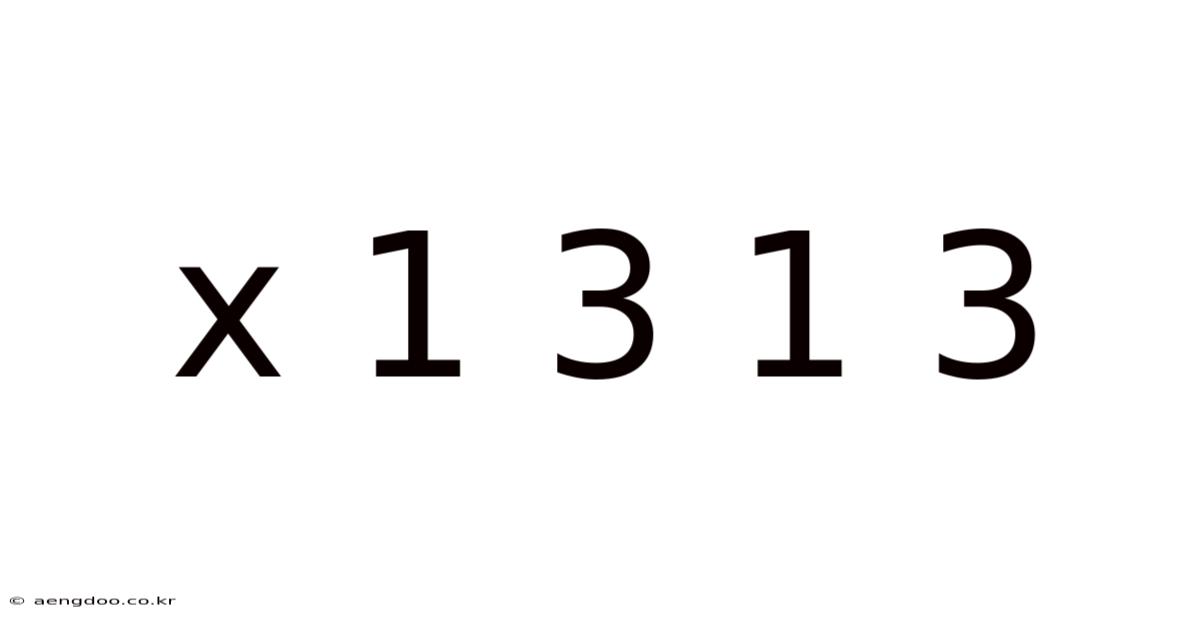
Decoding the Mysterious Sequence: x 1 3 1 3 – A Deep Dive into Patterns, Possibilities, and Problem Solving
The seemingly simple sequence "x 1 3 1 3" holds a captivating mystery. Its brevity belies a potential richness of interpretation, depending on the context and the rules governing its generation. This article will explore various perspectives on this sequence, examining possible patterns, mathematical interpretations, and practical applications, ultimately demonstrating the power of logical reasoning and problem-solving skills. We will dig into how understanding the unknown 'x' is key to unlocking the entire sequence's meaning The details matter here..
Understanding the Unknown: The Importance of 'x'
The presence of 'x' immediately introduces an element of ambiguity. Plus, it signifies an unknown variable, a missing piece of the puzzle. To decipher the sequence, we must first consider the possible nature of 'x'. And is it a number? A letter? A symbol representing a specific operation? The answer lies in identifying the underlying pattern or rule governing the rest of the sequence (1 3 1 3).
Several possibilities exist for 'x':
-
x as a numerical value: If 'x' is a number, we can explore various numerical relationships within the sequence. Does 'x' follow an arithmetic progression? A geometric progression? Or perhaps a more complex pattern? We could examine differences, ratios, or other mathematical relationships between consecutive terms.
-
x as an operator: 'x' could represent a mathematical operation such as addition, subtraction, multiplication, or division. If this is the case, the sequence might represent a series of operations leading to the subsequent numbers That's the part that actually makes a difference..
-
x as a symbolic placeholder: 'x' could be a placeholder for a specific element within a larger system or context. Perhaps the entire sequence is part of a code, a cipher, or a symbolic representation with a specific meaning within a particular field.
Exploring Potential Patterns and Sequences
Let's analyze the known portion of the sequence: 1 3 1 3. We can investigate various patterns:
-
Alternating Sequence: The simplest interpretation is an alternating sequence: 1, 3, 1, 3. This suggests a simple repetition. In this case, 'x' could be any value, as it wouldn't affect the subsequent repeating pattern. That said, this solution feels rather simplistic and lacks depth And that's really what it comes down to..
-
Arithmetic Progression with a Difference: We can examine the differences between consecutive terms. The difference between 1 and 3 is 2. The difference between 3 and 1 is -2. The difference between 1 and 3 is again 2. This alternating difference suggests a potential pattern, but doesn't immediately define 'x' And that's really what it comes down to..
-
Geometric Progression with a Ratio: A geometric progression involves multiplying each term by a constant ratio. This doesn't seem to apply directly to the sequence 1 3 1 3, as there is no consistent ratio.
-
Recursive Sequence: The sequence could be defined recursively, where each term depends on the preceding term(s). This requires further investigation and knowledge of the initial conditions, which we can potentially infer once we understand the nature of 'x'.
-
Fibonacci-like sequence with modification: While not a direct Fibonacci sequence (where each number is the sum of the two preceding ones), a modified version might be considered. A complex recursive relationship involving 'x' and the previous terms might generate this altered pattern Not complicated — just consistent. Took long enough..
Mathematical Interpretations and Modeling
To proceed, we need a more dependable framework. We could model this sequence using mathematical functions. The simplest function would be a piecewise function, where the value of the sequence depends on the position:
If we assume a basic repetition, a piecewise function could look like this:
- a<sub>n</sub> = 1 if n is even
- a<sub>n</sub> = 3 if n is odd
This doesn't incorporate 'x'. A more sophisticated model could include 'x' as a parameter influencing the sequence's growth or transformation. For example:
- a<sub>n</sub> = f(x, n)
where 'f' is a function that incorporates 'x' and the position 'n' in the sequence. The exact form of 'f' would need to be determined based on further information or constraints. Perhaps the function 'f' represents a transformation involving 'x', like a modulo operation or some other mathematical function That's the part that actually makes a difference. Took long enough..
The Context Matters: Real-World Applications and Scenarios
The interpretation of the sequence significantly depends on its context. Where did this sequence originate? What is its purpose?
-
Coding and Cryptography: This sequence could be a simplified part of a larger code or cipher. 'x' could be a key value, and the sequence represents a step in an encryption or decryption process. Understanding the encryption algorithm would be crucial And that's really what it comes down to..
-
Signal Processing: In signal processing, sequences like this could represent a simplified signal pattern. 'x' might represent the starting point or an initial condition that influences the subsequent signal values.
-
Game Theory or Puzzles: The sequence could be a part of a game or puzzle, where 'x' represents an unknown element the player must deduce.
-
Data Analysis and Statistics: The sequence could be a small subset of a larger dataset. 'x' might represent a missing data point or an outlier that needs further investigation.
Advanced Considerations and Potential Solutions
If we consider 'x' as a numerical value, we could explore relationships within the sequence that incorporate 'x' smoothly. Here's a good example: a potential pattern might involve alternating additions or subtractions based on 'x'. For example:
- x + 2 = 1 (implies x = -1)
- 1 - 2 = -1
- -1 + 2 = 1
- 1 - 2 = -1
In this scenario, the sequence becomes: -1, 1, -1, 1... This demonstrates that a specific numerical value for 'x' can lead to a consistent, albeit potentially different, pattern.
Alternatively, a more complex recursive relationship could be at play:
- a<sub>1</sub> = x
- a<sub>2</sub> = g(x)
- a<sub>3</sub> = h(a<sub>1</sub>, a<sub>2</sub>)
- a<sub>4</sub> = i(a<sub>2</sub>, a<sub>3</sub>)
where g, h, and i are functions that dictate how subsequent terms are derived from previous ones and 'x'. This highlights the significance of defining the functions which could lead to vastly different outcomes based on the choice of mathematical operation.
Frequently Asked Questions (FAQ)
Q: Is there a single definitive answer to the meaning of "x 1 3 1 3"?
A: No. Day to day, without additional context or constraints, there is no single definitive answer. The meaning is highly dependent on the underlying pattern or rule, which we can only infer with more information about the nature of 'x' and the context in which this sequence appears It's one of those things that adds up. But it adds up..
Real talk — this step gets skipped all the time Simple, but easy to overlook..
Q: How can I solve this type of problem more effectively?
A: Employ a systematic approach. Still, consider the broader context: where did this sequence come from? Consider this: start by considering all possibilities for 'x'. In real terms, explore various mathematical patterns (arithmetic, geometric, recursive) and functions. What is its intended purpose?
Q: What if the sequence continues beyond "1 3"?
A: More data points would significantly aid in determining the underlying pattern. A longer sequence provides more opportunities to identify meaningful relationships and test hypotheses Small thing, real impact..
Q: Can this sequence be represented graphically?
A: Yes, the sequence can be plotted on a graph with the position of the term (n) on the x-axis and the value of the term (a<sub>n</sub>) on the y-axis. This graphical representation can help visualize potential patterns.
Conclusion: The Power of Logical Reasoning and Open-Mindedness
The seemingly simple sequence "x 1 3 1 3" serves as a compelling example of the importance of logical reasoning, problem-solving, and open-mindedness. The ambiguity introduced by 'x' forces us to consider various possibilities and explore different mathematical interpretations. Plus, this exploration demonstrates how a seemingly simple sequence can unveil the complexity of mathematical thinking and the elegance of problem-solving. Because of that, the key to unlocking the mystery lies in understanding the context, defining the nature of 'x', and formulating a hypothesis that consistently explains the observed pattern. The journey to understanding this sequence highlights the rewarding aspects of inquisitive thought and the ever-present possibility of multiple valid interpretations depending on the context and underlying rules Worth keeping that in mind. Which is the point..
