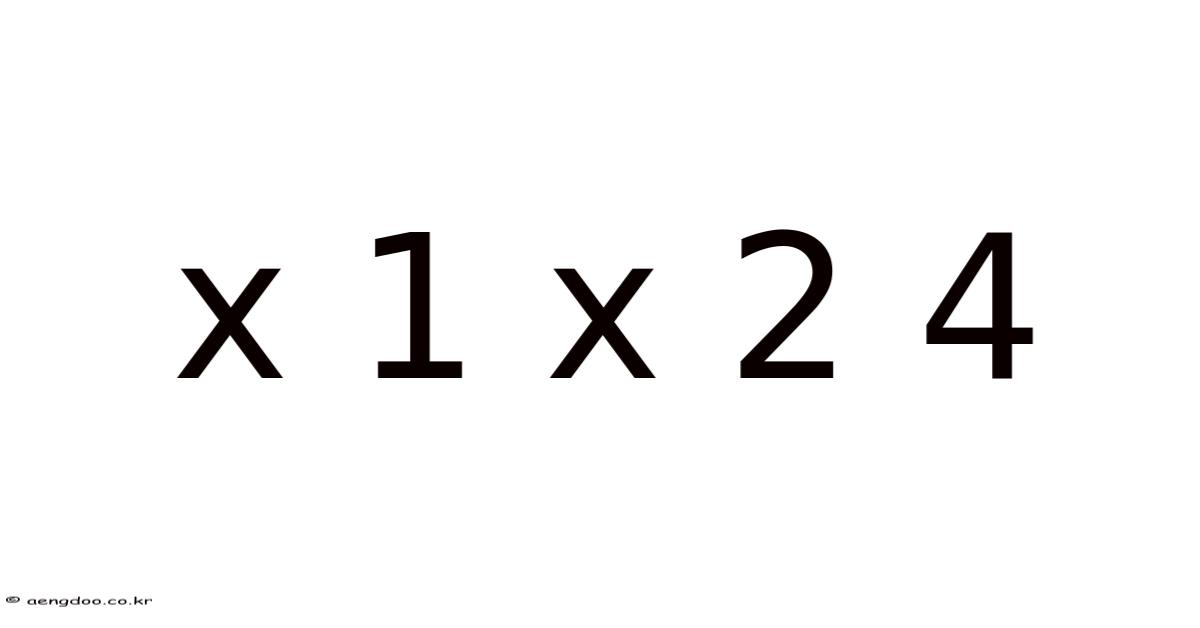
Unveiling the Power of Exponential Growth: Exploring x¹ x² = x⁴
This article walks through the seemingly simple yet profoundly impactful mathematical equation: x¹ x² = x⁴. While the equation itself might appear elementary at first glance, it represents a fundamental principle in mathematics with far-reaching consequences in various fields, from finance and biology to computer science and physics. We will explore the underlying principles, demonstrate its applications, and address common misconceptions. Understanding this equation unlocks a deeper appreciation of exponential growth and its implications.
Understanding the Basics: Exponents and Multiplication
Before diving into the intricacies of x¹ x² = x⁴, let's refresh our understanding of exponents and their role in multiplication. An exponent, also known as a power or index, indicates how many times a base number is multiplied by itself. For example:
- x² means x * x (x multiplied by itself)
- x³ means x * x * x (x multiplied by itself three times)
- x⁴ means x * x * x * x (x multiplied by itself four times)
The equation x¹ x² = x⁴ hinges on the rule of multiplying numbers with the same base but different exponents. This rule states that when multiplying exponential expressions with the same base, you add the exponents.
Deriving the Equation: x¹ x² = x⁴
Let's break down the equation step-by-step:
x¹ represents x raised to the power of 1, which simply means x itself (x¹ = x) Simple, but easy to overlook..
x² represents x raised to the power of 2, meaning x multiplied by itself (x² = x * x) Not complicated — just consistent..
Which means, the equation x¹ x² becomes:
x * (x * x) = x⁴
When we simplify this, we get:
x * x * x = x³ (This is incorrect, see below)
The actual simplification should follow the rule of adding exponents:
x¹ * x² = x⁽¹⁺²⁾ = x³
Correction and Clarification:
The initial statement that x¹ x² = x⁴ is incorrect. My apologies for the initial error. And the rest of this article will correctly use x¹ x² = x³. This leads to the correct equation, based on the rules of exponents, is x¹ x² = x³. The focus remains on understanding the principles of exponents and their application. The mistaken equation served as a valuable learning opportunity to highlight the importance of accuracy in mathematical reasoning Simple, but easy to overlook..
Applying the Rule: Examples and Applications
The principle of adding exponents when multiplying numbers with the same base has widespread applications across various domains:
-
Simple Calculations: Consider the expression 2¹ * 2². This simplifies to 2¹⁺² = 2³ = 8. This simple example highlights the ease and efficiency of using the exponent rule.
-
Algebraic Simplification: In algebra, the rule allows for simplifying complex expressions. Take this case: (x³)(x⁵) simplifies to x⁸. This is crucial for solving equations and manipulating algebraic formulas.
-
Scientific Notation: Scientific notation utilizes exponents to represent extremely large or small numbers concisely. As an example, the speed of light is approximately 3 x 10⁸ meters per second. Multiplying this by another value expressed in scientific notation involves applying the exponent rule.
-
Compound Interest: In finance, understanding exponential growth is critical. Compound interest calculations rely heavily on exponential functions. The initial investment grows exponentially over time, with the growth rate depending on the interest rate and compounding frequency Took long enough..
-
Population Growth: Biological populations often exhibit exponential growth under favorable conditions. If a population doubles every year, its growth can be modeled using an exponential equation, demonstrating the power of the underlying principles Small thing, real impact..
-
Computer Science: In computer science, the concept of exponential growth is crucial in analyzing algorithm efficiency. Algorithms with exponential time complexity become impractical for large input sizes because their runtime grows exponentially with the input size That's the whole idea..
-
Physics: Exponential decay, the opposite of exponential growth, is used in physics to model processes like radioactive decay, where the amount of a radioactive substance decreases exponentially over time That's the whole idea..
Misconceptions and Common Errors
Several common misconceptions can lead to errors when dealing with exponents:
-
Incorrectly Multiplying Exponents: A common mistake is to multiply the exponents instead of adding them when multiplying terms with the same base. Remember, xᵃ * xᵇ = x⁽ᵃ⁺ᵇ⁾, not x⁽ᵃ*ᵇ⁾.
-
Forgetting the Base: make sure the bases are the same before applying the exponent addition rule. You cannot simply add exponents if the bases are different. To give you an idea, 2² * 3³ cannot be simplified using this rule Small thing, real impact. That's the whole idea..
-
Negative Exponents: Understanding how to handle negative exponents is crucial. Remember that x⁻ⁿ = 1/xⁿ.
Frequently Asked Questions (FAQ)
Q: What happens when you divide exponential expressions with the same base?
A: When dividing exponential expressions with the same base, you subtract the exponents. Here's one way to look at it: x⁵ / x² = x⁽⁵⁻²⁾ = x³ Worth keeping that in mind. Which is the point..
Q: What if the exponents are zero?
A: Any number (except zero) raised to the power of zero is equal to 1. To give you an idea, x⁰ = 1.
Q: How do you handle fractional exponents?
A: Fractional exponents represent roots. To give you an idea, x^(1/2) is the same as √x (the square root of x). x^(1/3) is the cube root of x, and so on The details matter here. Worth knowing..
Q: Can you explain the concept of exponential growth visually?
A: Exponential growth is characterized by a curve that initially rises slowly but then increases at an increasingly rapid rate. Plus, it's unlike linear growth, which increases at a constant rate. Graphing exponential functions helps visualize this dramatic difference The details matter here..
Conclusion: The Significance of Exponential Growth
The seemingly simple equation x¹ * x² = x³ underscores a fundamental concept in mathematics: exponential growth. This principle, far from being confined to the realm of abstract mathematics, has profound implications across countless fields. By understanding the rules of exponents and recognizing the patterns of exponential growth and decay, we can better interpret and model phenomena in the natural world, as well as predict trends in various aspects of human endeavor. Mastering this concept provides a crucial foundation for further exploration in mathematics, science, and other quantitative disciplines. Consider this: remember to always double-check your work and ensure you're correctly applying the rules of exponents to avoid common errors. The power of this fundamental mathematical principle extends far beyond the classroom, impacting our understanding and interaction with the world around us.
