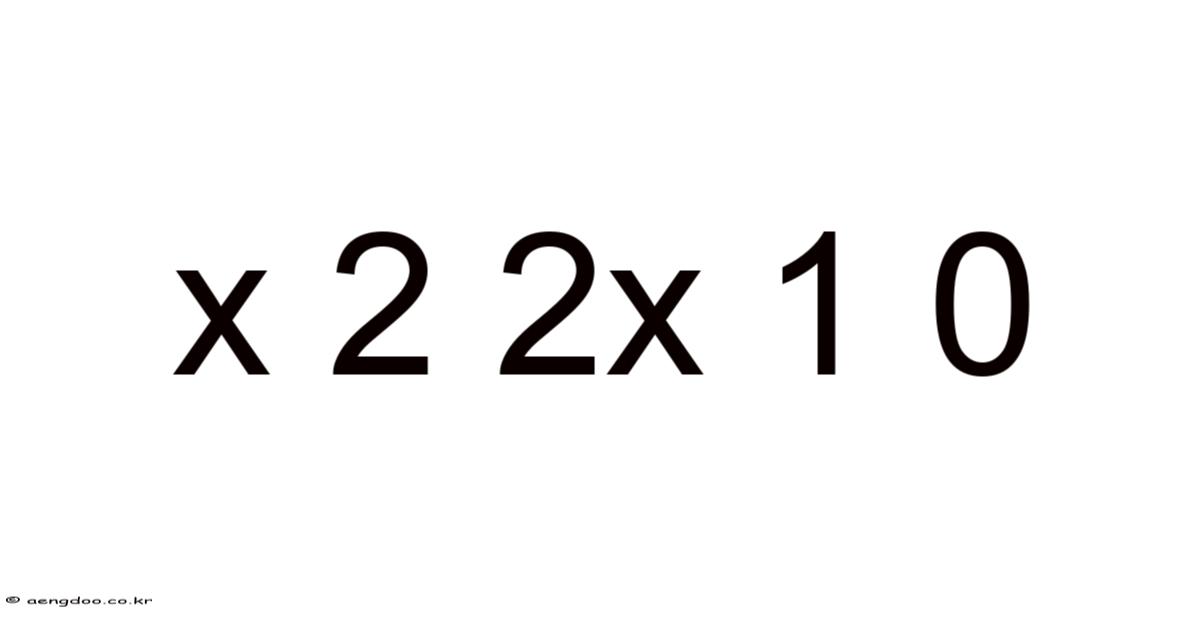
Decoding the Mystery: A Deep Dive into the Equation x² + 2x + 1 = 0
This article explores the quadratic equation x² + 2x + 1 = 0, examining its solution methods, underlying mathematical principles, and broader applications. And we'll move beyond simply finding the solution and walk through the 'why' behind the techniques, making this a thorough look for anyone curious about this fundamental equation in algebra. Understanding this equation provides a solid foundation for tackling more complex quadratic problems.
Introduction: Understanding Quadratic Equations
A quadratic equation is a polynomial equation of the second degree, meaning the highest power of the variable (usually 'x') is 2. Consider this: the general form of a quadratic equation is ax² + bx + c = 0, where 'a', 'b', and 'c' are constants, and 'a' is not equal to zero (otherwise, it wouldn't be a quadratic equation). Our focus, x² + 2x + 1 = 0, is a specific instance of this general form, with a = 1, b = 2, and c = 1 And that's really what it comes down to..
Method 1: Factoring the Quadratic Expression
This method relies on rewriting the quadratic expression as a product of two simpler expressions. Plus, notice that our equation, x² + 2x + 1, is a perfect square trinomial. This means it can be factored into the square of a binomial. Recall the formula (a + b)² = a² + 2ab + b². In our case, a = x and b = 1 Most people skip this — try not to..
Which means, x² + 2x + 1 can be factored as (x + 1)(x + 1) or (x + 1)².
Now, our equation becomes:
(x + 1)² = 0
To solve for x, we take the square root of both sides:
√(x + 1)² = √0
x + 1 = 0
Subtracting 1 from both sides gives us the solution:
x = -1
This means the equation x² + 2x + 1 = 0 has a single, repeated root at x = -1.
Method 2: Using the Quadratic Formula
The quadratic formula is a powerful tool for solving any quadratic equation, regardless of whether it's easily factorable. The formula is derived from completing the square and provides a direct way to find the roots. For the general quadratic equation ax² + bx + c = 0, the quadratic formula is:
x = [-b ± √(b² - 4ac)] / 2a
In our specific equation, x² + 2x + 1 = 0, we have a = 1, b = 2, and c = 1. Substituting these values into the quadratic formula gives:
x = [-2 ± √(2² - 4 * 1 * 1)] / (2 * 1)
x = [-2 ± √(4 - 4)] / 2
x = [-2 ± √0] / 2
x = -2 / 2
x = -1
Again, we find that the equation has a single, repeated root at x = -1 And it works..
Method 3: Completing the Square
Completing the square is another algebraic technique to solve quadratic equations. This method involves manipulating the equation to create a perfect square trinomial, which can then be easily factored Simple, but easy to overlook..
Starting with x² + 2x + 1 = 0:
-
Move the constant term to the right side of the equation: x² + 2x = -1
-
Take half of the coefficient of the x term (which is 2), square it (1² = 1), and add it to both sides of the equation: x² + 2x + 1 = -1 + 1
-
This creates a perfect square trinomial on the left side: (x + 1)² = 0
-
Solve for x as shown in Method 1: x = -1
Graphical Representation and the Parabola
Quadratic equations represent parabolas when graphed on a Cartesian coordinate system. The parabola for x² + 2x + 1 = 0 is a U-shaped curve. The solution to the equation, x = -1, represents the x-intercept of the parabola—the point where the parabola intersects the x-axis. Since we have a repeated root, the parabola touches the x-axis at only one point, (-1, 0), rather than intersecting it at two distinct points. The vertex of the parabola, which is the lowest point, also lies at x = -1. This indicates that the parabola is tangent to the x-axis at this point.
The Discriminant and the Nature of Roots
The expression b² - 4ac within the quadratic formula is called the discriminant. It determines the nature of the roots of a quadratic equation:
- Discriminant > 0: The equation has two distinct real roots. The parabola intersects the x-axis at two different points.
- Discriminant = 0: The equation has one repeated real root (a single root). The parabola is tangent to the x-axis. This is the case for our equation, x² + 2x + 1 = 0, where the discriminant is 0.
- Discriminant < 0: The equation has two complex conjugate roots (roots involving imaginary numbers). The parabola does not intersect the x-axis.
In our case, the discriminant is 2² - 4 * 1 * 1 = 0, confirming the single repeated root Turns out it matters..
Applications of Quadratic Equations
Quadratic equations are not just abstract mathematical concepts; they have numerous practical applications in various fields:
- Physics: Calculating projectile motion, determining the trajectory of objects under the influence of gravity.
- Engineering: Designing bridges, buildings, and other structures; analyzing stress and strain.
- Economics: Modeling supply and demand, determining optimal production levels.
- Computer Graphics: Creating curves and shapes for animations and visual effects.
- Finance: Calculating compound interest and determining investment growth.
Further Exploration: Beyond x² + 2x + 1 = 0
While we've focused on this specific equation, the principles and techniques discussed are applicable to a wide range of quadratic equations. Understanding these fundamentals empowers you to solve more complex problems, such as:
- Equations with different coefficients: Explore equations like 2x² + 5x + 2 = 0 or -x² + 3x - 2 = 0. Observe how changes in the coefficients affect the roots and the shape of the parabola.
- Equations with irrational or complex roots: Investigate equations that lead to roots containing square roots or imaginary numbers.
- Word problems involving quadratic equations: Practice applying quadratic equations to real-world scenarios. This will solidify your understanding of the practical applications of this powerful mathematical tool.
Frequently Asked Questions (FAQs)
Q: What does it mean for a quadratic equation to have a repeated root?
A: A repeated root means the parabola touches the x-axis at only one point. The quadratic expression can be factored into a perfect square, and the equation has only one solution No workaround needed..
Q: Can I use any method to solve a quadratic equation?
A: Yes, factoring, the quadratic formula, and completing the square are all valid methods. That's why the best method depends on the specific equation and your personal preference. Sometimes, factoring is the quickest, while the quadratic formula always works.
Q: What if the discriminant is negative?
A: A negative discriminant indicates that the quadratic equation has no real roots. The roots are complex numbers, involving the imaginary unit 'i' (√-1) That's the whole idea..
Q: Why is understanding quadratic equations important?
A: Quadratic equations are fundamental building blocks in algebra and have extensive applications in various scientific and engineering fields, making them an essential topic to master Turns out it matters..
Conclusion: Mastering the Fundamentals
The seemingly simple equation x² + 2x + 1 = 0 provides a gateway to understanding the broader world of quadratic equations. Remember that the key to success lies not just in memorizing formulas but in grasping the underlying concepts and their practical applications. By mastering the techniques presented – factoring, using the quadratic formula, and completing the square – you've equipped yourself with powerful tools for tackling more complex mathematical challenges. So, continue exploring, practicing, and expanding your mathematical knowledge – the possibilities are endless!
This is the bit that actually matters in practice Easy to understand, harder to ignore..
