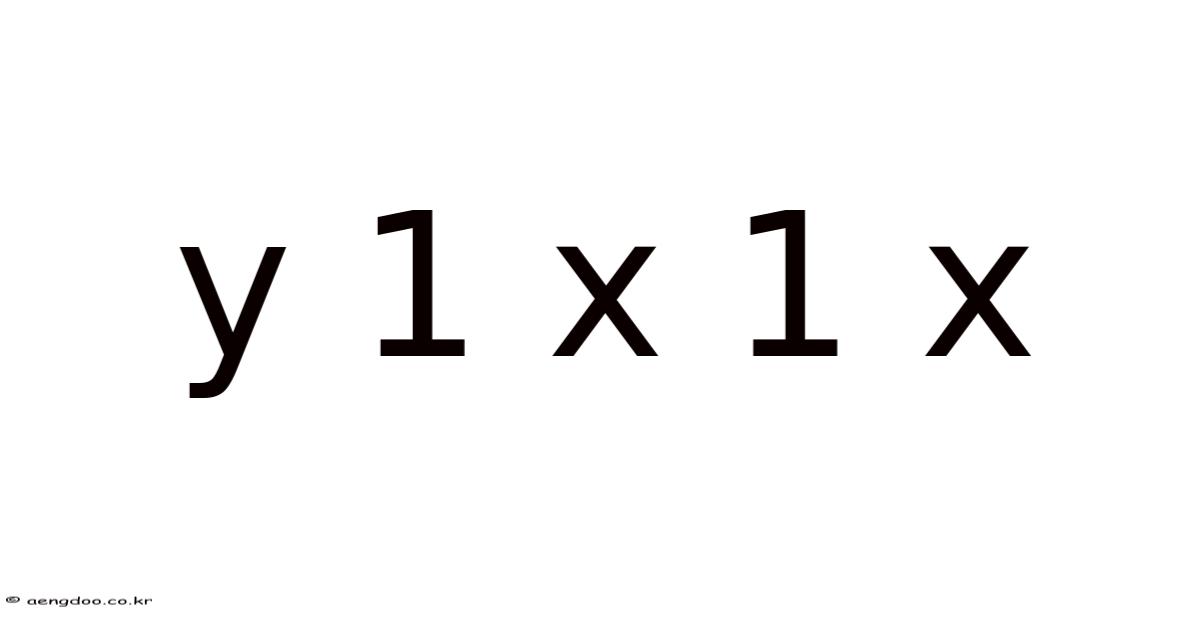
Decoding the Enigma: A Deep Dive into Y = 1 x 1 x ...
The deceptively simple equation, Y = 1 x 1 x ...But while seemingly trivial at first glance, it opens the door to exploring fundamental concepts in mathematics, highlighting the importance of precision, context, and the limitations of simple notation. , often encountered in early algebra or even casual mathematical discussions, presents a fascinating challenge. This article aims to unpack this seemingly simple equation, delving into its various interpretations, potential ambiguities, and the broader mathematical principles it touches upon.
Understanding the Core Problem: Ambiguity and Interpretation
The core issue with Y = 1 x 1 x ... That's why lies in its inherent ambiguity. The ellipsis (...) indicates a continuation, but without specifying the pattern of continuation, the equation remains undefined Less friction, more output..
-
Interpretation 1: Infinite Product of Ones: If we interpret the ellipsis to mean an infinite multiplication of ones (1 x 1 x 1 x 1 ... ad infinitum), then the answer is definitively 1. This is because multiplying any number by 1 does not change its value. No matter how many times we multiply 1 by itself, the result remains 1.
-
Interpretation 2: Finite Product of Ones: If the ellipsis represents a finite, but unspecified, number of ones, then the answer is also 1. Regardless of how many times we multiply 1 by itself a finite number of times, the product will always be 1 That's the part that actually makes a difference..
-
Interpretation 3: Hidden Variables or Patterns: The most intriguing interpretation introduces the possibility of a hidden pattern or variable. The ellipsis could be masking a more complex expression. As an example, it could represent a sequence: 1 x 1 x 2 x 1 x 3 x 1... where additional numbers are introduced. In this case, the equation becomes undefined until the pattern is clarified. This interpretation highlights the critical role of clear mathematical notation Simple as that..
Expanding the Scope: Exploring Related Mathematical Concepts
While the equation itself is simple, analyzing its potential interpretations brings forth several important mathematical concepts:
-
Infinite Products: The first interpretation touches upon the concept of infinite products. These are mathematical expressions involving the product of an infinite sequence of terms. Convergence and divergence are crucial aspects of infinite products. An infinite product converges if it approaches a finite limit. In the case of Y = 1 x 1 x ..., it trivially converges to 1. Other infinite products, however, might diverge, meaning they do not approach a finite limit.
-
Sequences and Series: The ambiguity of the ellipsis highlights the importance of defining sequences and series precisely. A sequence is an ordered list of numbers, while a series is the sum of the terms in a sequence. In the context of our equation, if we were to consider a sequence where the terms are 1, 1, 1, 1..., then the corresponding infinite product is the expression we are examining Which is the point..
-
Mathematical Notation and Precision: The equation powerfully demonstrates the importance of precise mathematical notation. The seemingly innocuous ellipsis hides a significant amount of ambiguity. Without explicitly defining the pattern or the number of terms involved, the equation remains undefined and opens itself to multiple interpretations. This emphasizes the need for clear and unambiguous notation in all mathematical expressions That alone is useful..
-
Limits and Continuity: In calculus, the concept of limits is fundamental. A limit describes the value a function or sequence approaches as its input approaches a particular value. When dealing with infinite products, the notion of limits is essential to determine whether the product converges or diverges. Our simple equation, in its simplest interpretation, showcases a trivial limit of 1.
A Deeper Dive into Infinite Products: Convergence and Divergence
Infinite products, as mentioned earlier, are a fascinating area of mathematics. Consider a more complex infinite product:
∏_(n=1)^∞ (1 - 1/n²)
This product involves a sequence where each term is (1 - 1/n²). Unlike our simple equation, this infinite product converges to a specific value. Analyzing its convergence or divergence often involves techniques from calculus, such as using logarithms to transform the product into a sum and then applying tests for the convergence of infinite series Worth keeping that in mind..
Practical Applications and Real-World Examples
Although Y = 1 x 1 x ... seems abstract, the underlying concepts find applications in various fields:
-
Probability and Statistics: Infinite products are often used in probability theory to calculate the probability of independent events occurring. Here's one way to look at it: the probability of flipping a coin and getting heads infinitely many times is an infinite product involving probabilities It's one of those things that adds up. Still holds up..
-
Physics and Engineering: Infinite product representations appear in solutions to certain differential equations in physics and engineering, particularly those involving oscillations or waves. Understanding convergence and divergence is crucial for interpreting these solutions Not complicated — just consistent..
-
Financial Modeling: In financial mathematics, infinite products might be used to model compound interest or the behavior of financial markets over an extended period Still holds up..
Frequently Asked Questions (FAQs)
Q: Is Y = 1 x 1 x ... always equal to 1?
A: Not necessarily. The answer is definitively 1 only if the ellipsis represents an infinite product of ones or a finite product of ones. On the flip side, if a hidden pattern or sequence is implied, the result will depend on the nature of that pattern Simple, but easy to overlook..
Q: How can I determine the value of Y if there's a hidden pattern?
A: Determining the value requires understanding the hidden pattern. This might involve analyzing the sequence of numbers, looking for a mathematical formula or relationship governing the terms, and then evaluating the infinite product (if applicable) using appropriate mathematical techniques.
Q: What if the ellipsis represents a product of numbers other than 1?
A: The result will depend entirely on the numbers involved and whether the product converges or diverges. As an example, if the ellipsis represented 2 x 2 x 2 x ..., the product would diverge to infinity It's one of those things that adds up. Worth knowing..
Conclusion: The Power of Precision and Context
The seemingly simple equation, Y = 1 x 1 x ...While the simplest interpretation leads to a trivial answer of 1, the equation opens the door to exploring a wide range of mathematical concepts, including infinite products, sequences, series, limits, and convergence. Consider this: , serves as a powerful reminder of the importance of precise mathematical notation and context. Understanding these concepts is not only crucial for mathematicians and scientists but also finds applications in diverse fields ranging from probability and statistics to physics and finance. The ambiguity of the equation highlights the critical need for clarity and precision when dealing with mathematical expressions, emphasizing that even the most basic-looking equations can hide profound mathematical depth.
